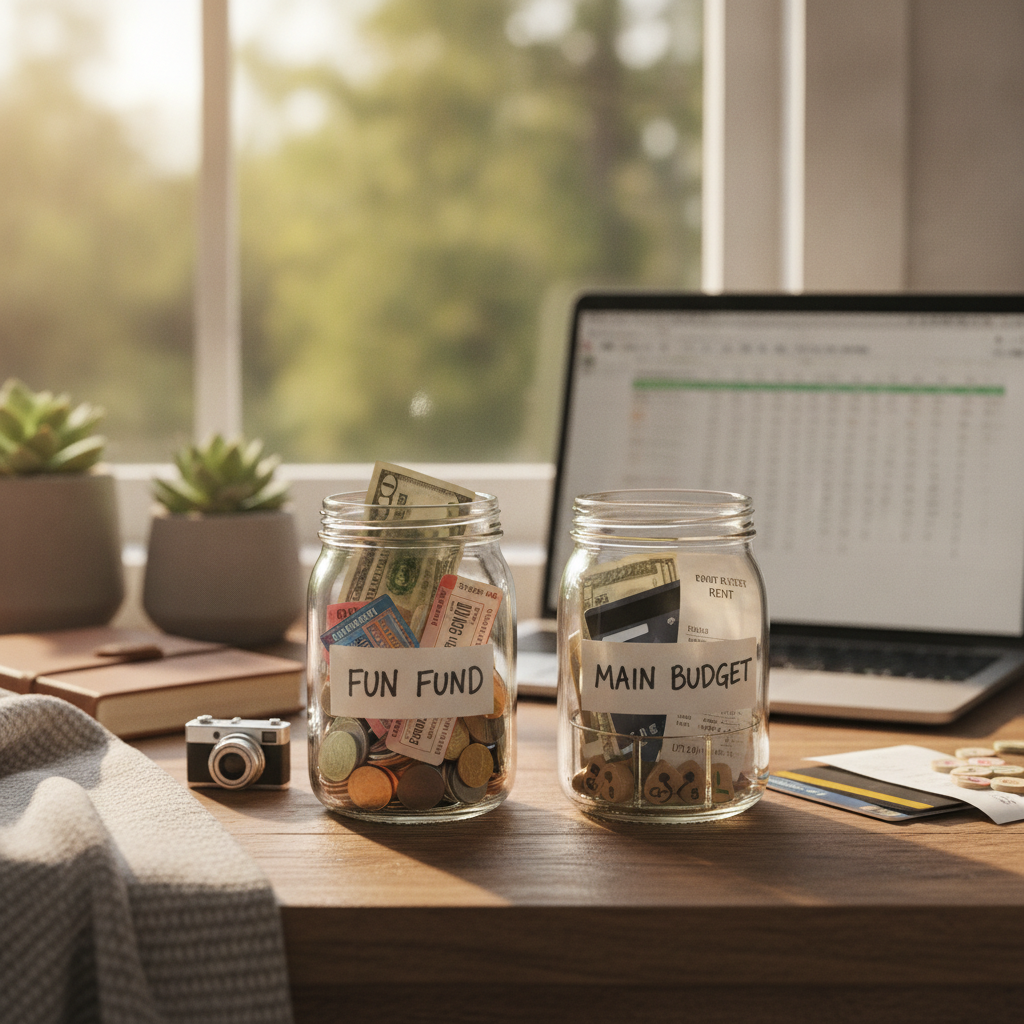
Every well-constructed budget contains a quiet tension between discipline and livability — and how that tension gets resolved determines whether a person actually sticks to the plan or quietly abandons it by the third week of the month.
The Problem with Perfectly Categorized Budgets
Most budgeting frameworks — whether it's the envelope system, zero-based budgeting, or a standard 50/30/20 split — treat discretionary spending as a single block or carve it into labeled categories like dining, entertainment, and clothing. The logic is sound on paper: name every dollar, track every category, leave nothing ambiguous. But in practice, this level of categorization creates a strange kind of paralysis. When someone wants to grab a last-minute concert ticket, buy a book that wasn't on the list, or try a restaurant just because it looked good on a walk home, the system doesn't accommodate spontaneity — and spontaneity is part of what makes life feel worth living.
What a Fun Fund Actually Is
A fun fund — sometimes called a "joy budget" or, in Japanese personal finance culture, a *yorokobi-hi* (喜び費, loosely translated as "happiness expenditure") — is a small, intentionally separate pool of money set aside for spending that has no justification beyond personal pleasure. It's not dining out with friends (that's social), not a new pair of running shoes (that's health or clothing), and not a streaming subscription (that's entertainment). It's a category that exists outside of categories, reserved for the small, unplanned moments of spending that feel purely indulgent — and that a rigid budget would otherwise make you feel guilty about. The fund is modest by design: small enough to protect your real financial goals, large enough to matter emotionally.
Why Guilt-Free Spending Has Real Financial Value
Behavioral economists have long observed that overly restrictive budgets tend to fail not because the math is wrong, but because they leave no room for psychological relief. When every purchase must be justified and categorized, spending starts to feel like a transgression the moment it strays from the plan — and that guilt often triggers a kind of financial "what's the point" spiral that ends in abandoned budgets and unchecked splurges. A dedicated fun fund works as a pressure valve. By pre-authorizing a small amount of consequence-free spending, it removes the shame from the equation entirely. YNAB (You Need a Budget), one of the more widely used budgeting apps, actually encourages users to create a category specifically for this purpose, understanding that psychological sustainability is as important as mathematical precision.
How to Set the Right Size Without Undermining Your Goals
The size of a fun fund should feel meaningful without being a workaround for a larger spending problem. For most people, this lands somewhere between the cost of a nice dinner out and a modest weekend activity — an amount that feels like a real treat but doesn't require shifting money away from savings, debt repayment, or essential categories. The key is to set it as a fixed line in the monthly budget, not a leftover after everything else is funded, which would make it variable and easy to eliminate. Treating it with the same intentionality as a rent payment or a transfer to a Marcus by Goldman Sachs savings account — scheduled, protected, non-negotiable — is exactly what gives it its power. When the fund runs out, it runs out. That boundary is part of the structure.
Keeping It Separate Protects the Rest of Your Budget
The "separate" part of this idea is not incidental — it's central to how the fund works. When fun money lives inside a general discretionary category, it mingles with dining budgets and clothing allowances, making it nearly impossible to track where the spontaneous spending ends and the planned spending begins. Keeping it in its own digital envelope within an app like Monarch Money, or even in a separate low-balance debit account, creates a clear psychological and practical firewall. You can see when it's full, when it's running low, and when it's gone — and that visibility makes the whole system more honest. The boundaries between categories stop being porous, and the rest of your budget stays cleaner as a result.
The Cultural Permission to Spend on Pleasure
In many Western financial cultures, spending money on something purely pleasurable — something that doesn't build equity, improve health, or serve a social obligation — carries a faint but persistent stigma. The Dutch concept of *niksen* (the art of doing nothing productive, embraced as restorative) offers an interesting counterpoint: it frames purposeless rest as legitimate and necessary, not wasteful. A fun fund applies that same logic to money. It grants cultural permission to spend on pleasure without requiring that the pleasure be useful. That reframe matters, because the psychological cost of constant financial self-denial tends to accumulate quietly — until it doesn't, and the budget collapses under the weight of suppressed want.
Making the Fun Fund a Permanent Part of Your Financial Identity
Once you start treating a fun fund as a permanent budget line rather than a temporary indulgence, something shifts in how you relate to your finances overall. Budgeting stops feeling like a punishment system and starts feeling like a tool that actually works in your favor. The spontaneous purchase — a book from Powell's, a train ticket to somewhere nearby, a meal you didn't plan for — no longer carries anxiety, because you've already made room for it. That shift in emotional relationship to money is, arguably, one of the more underrated markers of genuine financial health: not just the absence of debt or the presence of savings, but the quiet confidence that your system has room for you to be human inside it.
Every budget built on discipline alone eventually meets its limit. The budgets that last are the ones built around real life — including the small, unplanned moments of spending that make real life worth funding in the first place.