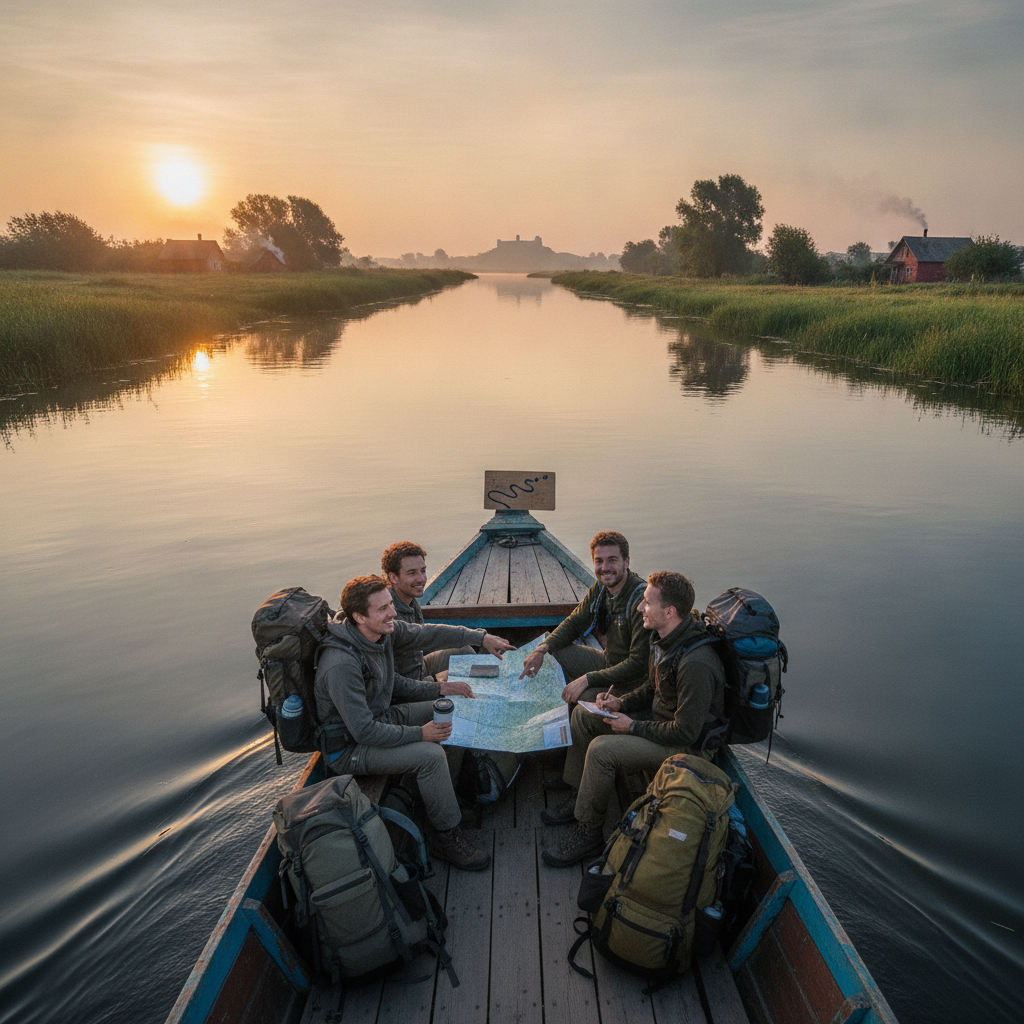
There is a particular kind of traveler who arrives in Budapest, ticks off the thermal baths and the ruin bars, and then boards a flight to Belgrade two days later — paying for two city hotels, two sets of airport transfers, and two rounds of tourist-zone restaurant prices, all to see places that are actually connected by one of Europe's most navigable rivers. The Danube doesn't just pass through this part of Central and Eastern Europe; it defines it. And for anyone willing to slow down and follow the water rather than the flight map, it offers something rarer than a scenic backdrop: a coherent, low-cost travel structure that consolidates what most itineraries treat as three disconnected destinations into a single, affordable arc.
The Logic of River Travel as a Budget Structure
Most travelers think of transport as the connective tissue between destinations — something to endure in order to arrive somewhere worth being. But on the Danube corridor between Budapest and Novi Sad, the journey itself becomes the framework, and that shift in thinking changes the economics of the whole trip. Instead of budgeting separately for three city bases, three sets of check-ins, and the hidden costs that cluster around tourist centers — overpriced breakfasts, inflated taxi rides from central hotels, entry-fee stacking — a river-route approach allows a traveler to allocate one accommodation budget, one transport budget, and one food budget across a continuous experience. The savings aren't theoretical. They emerge from the structural decision to move slowly and linearly rather than hopping between fixed points.
The specific route that earns the most attention among budget-conscious slow travelers runs from Budapest south through the Ráckeve branch of the Danube, past the Great Hungarian Plain — known locally as the Alföld — and across the Serbian border toward Novi Sad and the Vojvodina region. This stretch passes through landscapes that haven't been priced for tourism in the way that Budapest's Seventh District or Belgrade's Savamala neighborhood have been. Guesthouses in towns like Kalocsa or Baja charge a fraction of what a mid-range Budapest hotel costs per night, and the Danube ferries and regional buses connecting these stops operate on fares that feel almost anachronistic by Western European standards.
Replacing Fixed City Hotels With a Moving Base
The conventional Budapest-then-Belgrade itinerary requires a traveler to pay peak city-center accommodation rates at both ends — and often a hostel or budget hotel in Novi Sad as a third stop — without any structural reason to connect those stays. A river-route framework replaces that logic with a moving base, where each overnight stop is chosen not because it appears on a highlights list but because it sits at a natural point along the corridor and offers cheaper, quieter accommodation than the cities on either side. The Hungarian town of Baja, for instance, sits at the confluence of the Sugovica and the Danube and offers genuinely charming guesthouses at prices that would represent excellent value even by regional standards. It's not a city-break destination. That's precisely what makes it useful as a budget anchor.
In Serbia, the Vojvodina plain introduces a different atmosphere entirely — flatter, more agrarian, marked by the kind of unhurried provincial life that travelers rarely encounter when they confine themselves to capital cities. Towns like Sremski Karlovci, just upstream from Novi Sad, offer wine-cellar stays and riverside guesthouses at rates that haven't absorbed the tourism premium that Novi Sad's center is beginning to develop. By treating these smaller stops as the actual accommodation base and Novi Sad as a half-day excursion, a traveler extracts the cultural value of the larger city without paying for it overnight — one of the cleanest budget moves available on this corridor.
Food, Markets, and the Real Cost of Eating Along the Water
The culinary culture of the Hungarian and Serbian lowlands is built around abundance in a way that suits a tight travel budget remarkably well. The piac — the Hungarian word for market — appears in almost every town of any size along this route, and the Serbian equivalent, the pijaca, operates on similar principles: fresh produce, prepared foods, and local cheeses and meats sold at prices oriented toward residents, not visitors. A traveler who builds even two or three meals a week around these markets rather than restaurants can redirect meaningful spending toward experiences, transport, or simply extending the trip. This isn't deprivation eating. The smoked fish along the Danube, the fresh paprika-heavy stews sold from market stalls in Kalocsa, and the flatbread variations found throughout Vojvodina are genuinely good — and they cost almost nothing compared to what a midrange restaurant in Budapest's tourist core would charge for a simplified version of the same flavors.
Restaurant meals along the smaller stops on this route are also cheap by any reasonable measure. A full sit-down lunch in Baja or Sremski Karlovci, with a regional wine, typically costs less than a fast-casual meal near a Budapest metro stop. The key is simply being present in places where the local economy sets the price rather than the tourism economy.
What You Save by Treating the Route as One Journey
When you map the actual costs of a conventional three-city itinerary against a slow river-route approach covering the same geography, the difference is consistent and meaningful. The city-hopping version accumulates airport or train-station transfer costs at each end, pays central accommodation rates that reflect demand rather than value, and tends to cluster spending in tourist zones where every purchase carries a markup. The river route, by contrast, distributes costs across a longer timeline at a lower daily rate — a pattern that aligns naturally with what budget travelers who move slowly have always known: that the per-day cost of a trip falls significantly when you stop relocating every forty-eight hours.
Apps like Rome2rio make it straightforward to map the regional bus and ferry connections along this corridor, and booking accommodation through smaller local platforms or direct guesthouse contact often undercuts what the major booking sites list. The infrastructure exists. The route is not obscure or difficult. It simply requires choosing a linear, unhurried approach over the reflex to optimize for volume of cities visited — a reframing that pays dividends not just financially but in the quality of what the trip actually feels like from the inside.
There is something fitting about returning, at the end of this kind of journey, to the logic of the river itself — which has always moved in one direction, at its own pace, connecting places that share a geography without needing to make each one a separate event. The traveler who arrived in Budapest calculating the cost of three separate city stays may find, somewhere along the Danube's slow southern curve, that the most affordable version of this journey was always the one that followed the water.