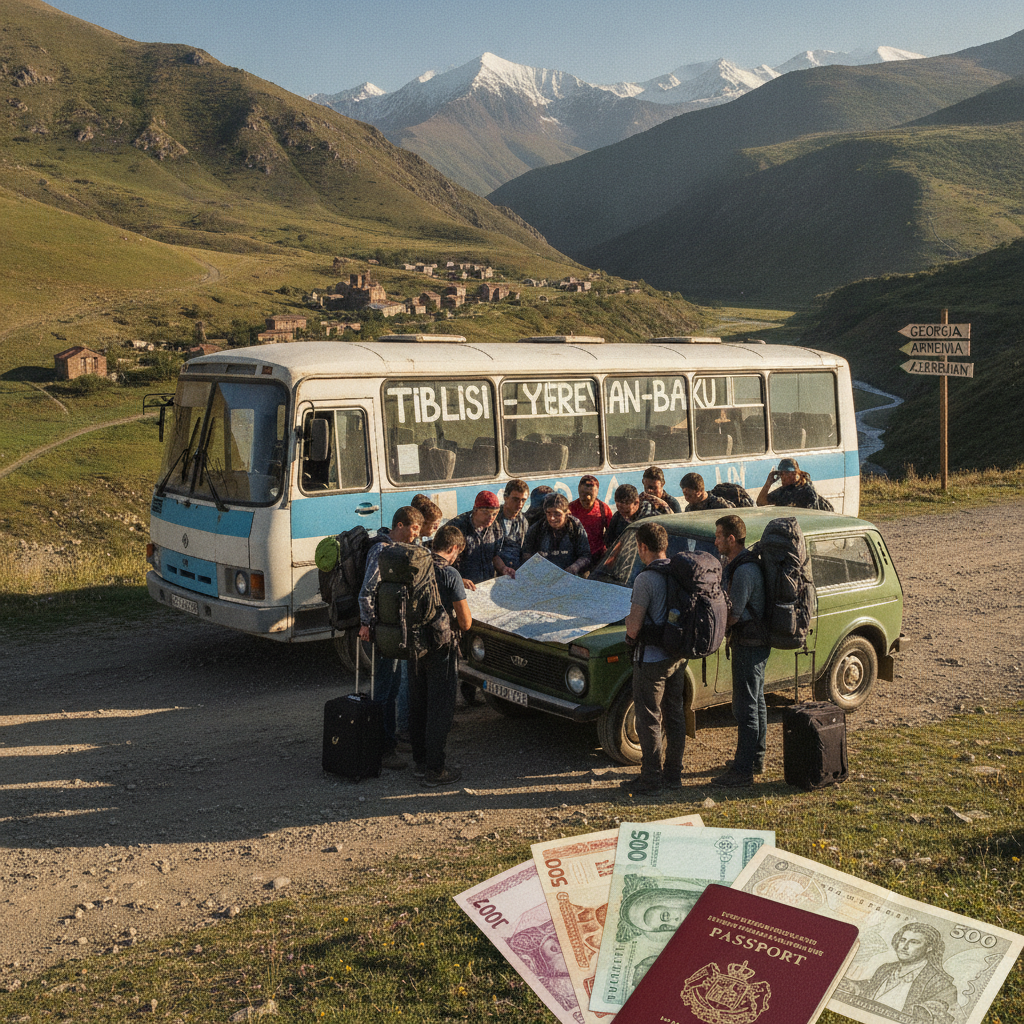
There is a particular kind of traveler who arrives at an airport, boards a connecting flight, and never quite sees the country between departure and destination. The Southern Caucasus — that compact, improbable region where Georgia, Armenia, and Azerbaijan press against each other between the Black Sea and the Caspian — has long been the kind of place that rewards a different approach. The overland route that stitches these three countries together is not only possible on a modest regional bus budget; it is, by most measures, the more interesting way to travel.
Understand Why Overland Travel Wins Here Financially
Flying between Tbilisi, Yerevan, and Baku costs multiples of what the bus and shared taxi routes do — and the distances involved don't justify the airport overhead. The Caucasus is geographically compact in a way that makes overland movement practical. A marshrutka — the Russian-derived word for a shared minibus that operates throughout the region — covers the Tbilisi-to-Yerevan corridor in roughly five to six hours, at a fraction of any airfare. When accommodation, meals, and entry costs already stretch a tight travel budget, cutting the transport line entirely is where the meaningful savings begin.
Map the Route Before You Book Anything
The standard circuit runs Tbilisi to Yerevan, then Yerevan to the Iranian or Georgian border, and — for travelers who hold the right passports — onward to Baku. It's worth mapping this route in full before committing to a direction of travel, because the Nagorno-Karabakh conflict has left the Armenia-Azerbaijan border closed. The practical implication is that traveling between Armenia and Azerbaijan requires returning through Georgia as a transit point. This adds a short additional leg but doesn't dramatically change the cost. Google Maps works well enough for route planning here; for ground-level scheduling, the app Rome2rio gives a usable overview of overland options and approximate journey times.
Start in Tbilisi and Let the Budget Flow Outward
Georgia's capital functions as the natural gateway for most international arrivals. Tbilisi is one of the more affordable capital cities in the broader European and Central Asian orbit, with guesthouse beds in the Marjanishvili neighborhood running well under the cost of comparable European budget accommodations. More importantly, the city is the regional transport hub. The Didube bus station — a sprawling, chaotic, deeply functional place — is where most marshrutka services to Armenia originate. Buying tickets the morning of departure is normal practice; there's little need to book in advance for most routes, which keeps flexibility intact and removes booking fees.
Cross Into Armenia on the Ground and Save the Difference
The Tbilisi-to-Yerevan marshrutka crosses at the Bagratashen-Sadakhlo border point, a crossing that operates regularly and moves efficiently by regional standards. Yerevan itself — compact, walkable, built around the pedestrian stretch of Abovyan Street — is a city that rewards slow movement. The Armenian dram stretches reasonably well for food and accommodation, and the metro system is both cheap and functional. For travelers continuing to Baku, the return leg to Tbilisi can be managed in a single long day. The key budget principle at work here is consolidation: every border crossed overland eliminates an airport transfer, a checked bag fee, and the invisible cost of arriving in a city exhausted and underprepared.
Factor in the Visa Costs Early, Not Late
Georgia offers visa-free entry to most passport holders. Armenia does as well, for a broad range of nationalities. Azerbaijan operates a different system — the e-visa, known as ASAN Visa, is straightforward to obtain online, but it does carry a fee that should be budgeted for before departure rather than absorbed as a surprise. The broader point is that this region is not visa-hostile for most Western travelers, but costs vary enough that checking the specific requirements for each country before finalizing a route prevents the kind of mid-trip recalculation that disrupts a carefully assembled budget. A simple spreadsheet with per-country entry costs, transport estimates, and accommodation ranges takes twenty minutes to build and pays for itself immediately.
Eat and Sleep the Way Locals Actually Do
The Caucasus has a food culture that is both deeply regional and extraordinarily affordable for travelers. In Georgia, a khinkali — a large, soup-filled dumpling — costs very little per piece and functions as a full meal when ordered in a group of eight or ten. In Armenia, lahmajoun (a thin, spiced flatbread sometimes called Armenian pizza) is sold from small bakeries for pocket change. Eating at sit-down restaurants in tourist zones is where budgets quietly erode. The guesthouses that cluster around transit hubs in all three capitals often include breakfast, and the savings from a few included meals each week are worth prioritizing when choosing where to stay.
Let the Journey Absorb the Cost of the Itinerary
There is a financial philosophy embedded in overland travel that goes beyond the price of a bus ticket. When the journey itself is the structure — when moving between countries happens slowly enough to notice the landscape shifting from the forested gorges above the Mtkvari River to the dry, rust-colored plains outside Yerevan — the traveler stops paying for experiences to fill the gaps between transit. The Caucasus overland route works as a budget strategy precisely because it inverts the usual travel logic: instead of flying quickly between destinations and spending more once arrived, the movement slows, the cost drops, and the texture of the region accumulates naturally.
The traveler who stood at Didube station in Tbilisi at seven in the morning, watching a marshrutka fill with produce vendors and students and a pair of elderly women carrying bags of apples, was not cutting corners. They were choosing a way of moving that cost less and revealed more. That trade, repeated across three borders and several hundred kilometers of Caucasian road, is exactly what a well-built travel budget is supposed to make possible.