There are places in the world where the calendar does the heavy lifting for budget travelers. Eastern Europe in late autumn is one of them — a stretch of weeks, roughly from mid-October through late November, when crowds thin, prices soften, and cities that spend their summers overwhelmed by tourism quietly return to something closer to their real selves.
This isn't an obscure discovery or a contrarian take. It's a well-established pattern among travelers who've learned to watch the rhythms of a destination as closely as its sights. The question worth sitting with is why more people don't time their trips accordingly — and what exactly is waiting for those who do.
What Happens to Prices When the Crowds Leave
Across cities like Kraków, Bucharest, and Ljubljana, the economics of late-autumn travel work in a visitor's favor in several layered ways. Hotel occupancy drops sharply after the summer peak and again after the October school holiday window closes, which pushes accommodation rates down noticeably. Budget properties — guesthouses, small family-run hotels, hostels with private rooms — often reduce their nightly rates by a meaningful margin compared to July pricing. Airlines serving routes into regional hubs like Warsaw Chopin or Budapest Ferenc Liszt follow similar logic: fewer seats sold means more competitive fares, especially on the mid-week departures that fill last.
The effect compounds. When fewer tourists are competing for the same restaurants, local spots that might feel crowded or rushed in summer become genuinely relaxed. Menus don't shift toward English-only tourist pricing. A bowl of *żurek* — the sour rye soup that's a staple of Polish cuisine — at a neighborhood milk bar (*bar mleczny*) in Kraków costs the same as it always has, because the clientele is mostly local.
The Cultural Texture of the Off-Season
Late autumn in Eastern Europe carries its own cultural weight that the summer calendar simply doesn't offer. This is the season of *Zaduszki* in Poland — the All Souls' Day observance on November 2nd, when families gather at cemeteries to light candles for the deceased. The effect is quietly extraordinary: thousands of small flames across old cemetery grounds in the early evening, a tradition that has continued through decades of political upheaval and feels entirely unperformed for visitors.
In Romania, the weeks before winter bring harvest-related festivals, outdoor markets selling *țuică* (a traditional plum brandy), dried mushrooms, and handmade ceramics. In the Czech Republic, the St. Martin's Day goose feast on November 11th marks the symbolic start of the wine season, when young *svatomartinské víno* — the year's first wine — is released and celebrated in Prague's wine bars and countryside restaurants alike. These are not tourist-facing events manufactured for Instagram. They exist because the culture created them, and travelers who arrive in this window get to witness them without any particular effort or expense.
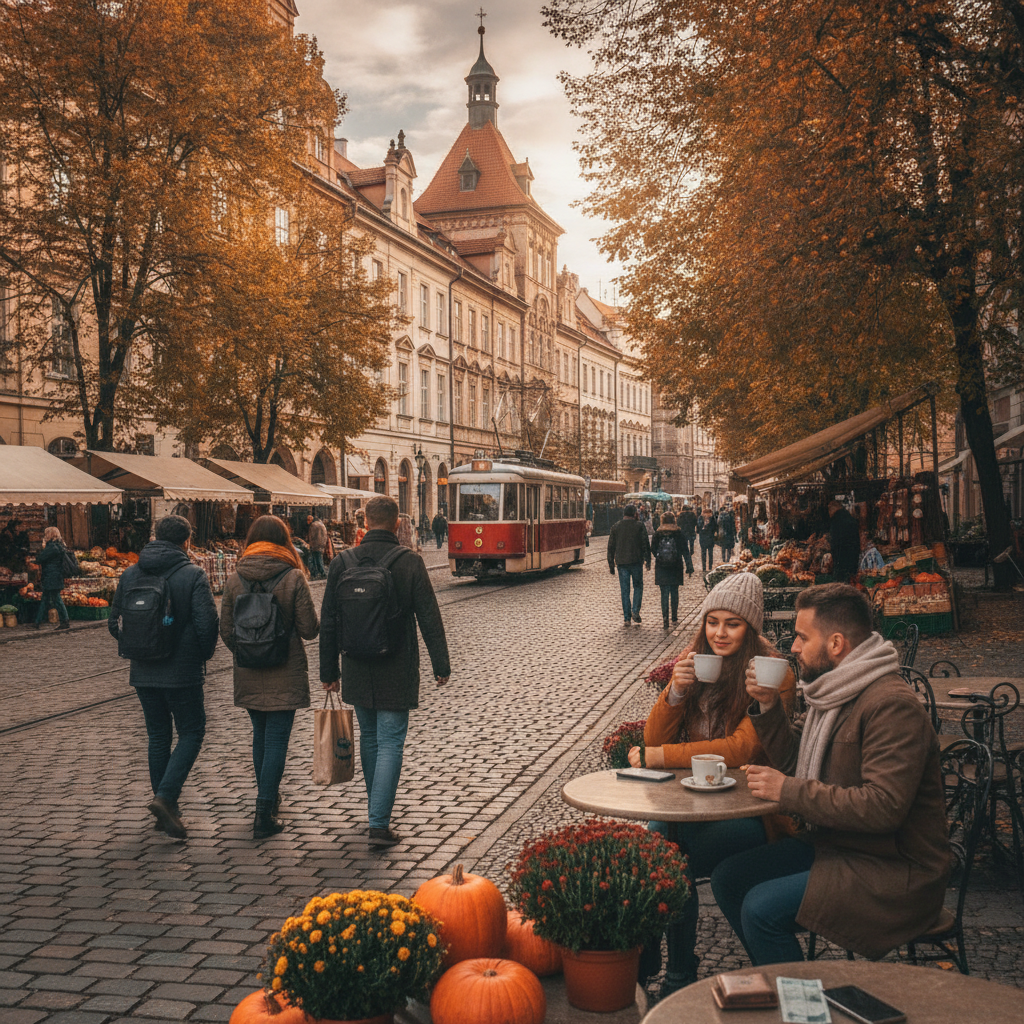
The light itself deserves mention. Late-autumn light in Central and Eastern Europe — low, golden, arriving briefly in the afternoon — transforms cities architecturally. The baroque facades of Bratislava's old town and the medieval squares of Tallinn read differently under November sky than they do in the flat brightness of midsummer.
Planning the Trip Without Overcomplicating It
For anyone considering this kind of trip, the practical framework is simpler than it might appear. Flights into secondary airports — think Katowice instead of Kraków, or Weeze instead of major German hubs for onward connections — often carry lower fares, and the ground transport connections are well-established. Apps like Omio make cross-border train and bus routes across the region easy to price and book without requiring separate searches on a dozen national rail websites.
Accommodation in this window rewards flexibility. Booking seven to ten days out, rather than months in advance, often yields better rates at quality guesthouses that would otherwise sit partially empty. This is the opposite of summer logic, where early booking protects against sellouts. In late autumn, the inventory is there — the leverage belongs to the traveler.
Packing for this window means preparing for genuine cold, particularly in the evenings. Temperatures in Warsaw or Prague in November can drop well below freezing after dark. But that's also part of the experience — the warmth of a wine bar or a *pivnice* (a traditional Czech beer cellar) feels earned when the street outside is cold and quiet.
What the Season Rewards
Traveling Eastern Europe in late autumn asks for a particular mindset: comfort with slower pace, appreciation for detail over spectacle, and a willingness to eat and drink like a local rather than like someone following a curated highlights reel. The rewards it returns are correspondingly specific — unhurried mornings in city museums, conversations with guesthouse owners who actually have time to talk, meals that cost a fraction of what comparable quality would run in Western Europe.
This is value travel at a more nuanced register than simply finding cheap flights. It's about arriving in a place when the place is most honestly itself. The budget benefits are real and consistent, but they arrive alongside something less quantifiable: the sense of having encountered a destination rather than just passed through it.
Looking ahead, this window is likely to stay favorable for at least the near term. Several Eastern European cities are seeing gradual infrastructure investment and a slow uptick in year-round tourism interest — Tbilisi in Georgia and Novi Sad in Serbia have both drawn increasing attention. As awareness of these destinations grows, the late-autumn advantage may narrow over time. For now, though, the combination of accessible pricing, cultural depth, and genuine quiet that defines this season across the region remains one of the more honest bargains in contemporary travel.