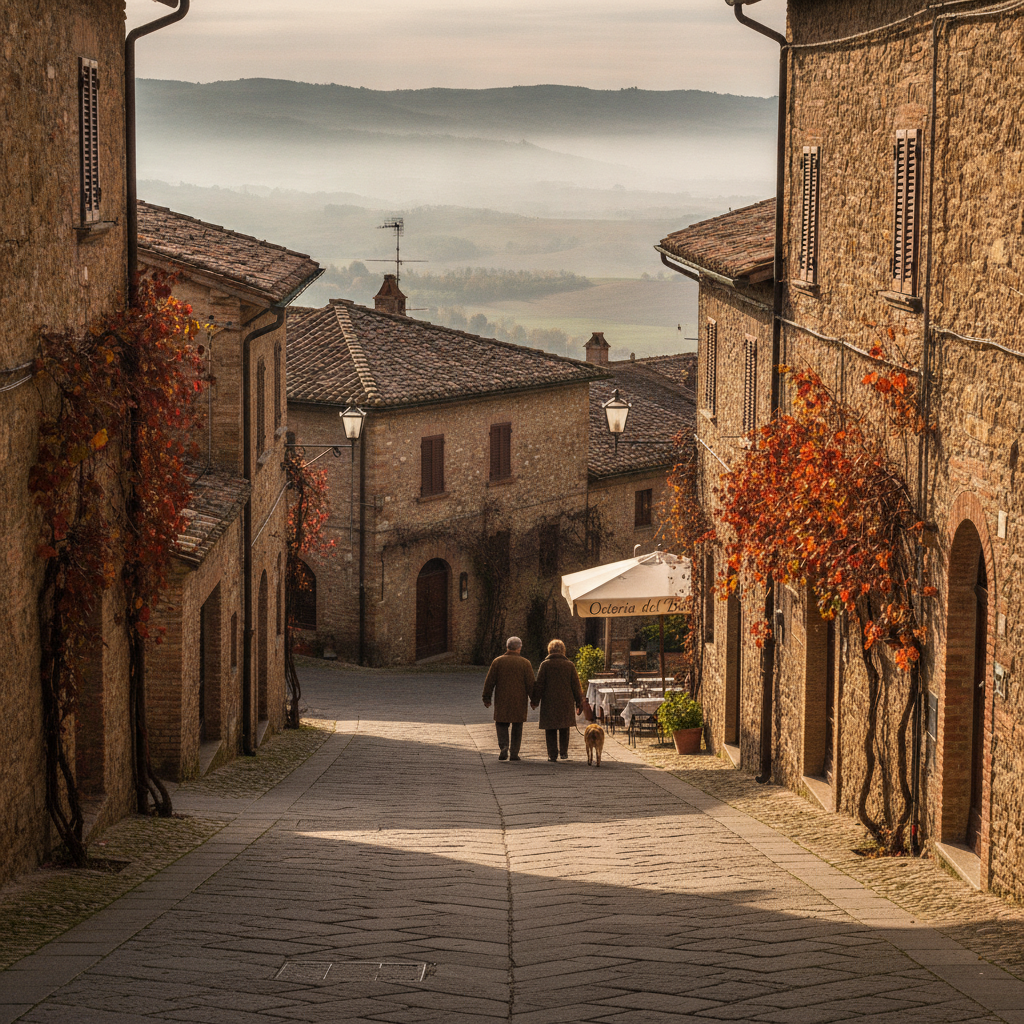
Tuscany has priced itself into a different category. Not unreachable, but no longer the effortless budget destination it once was — not when a modest agriturismo near Siena now commands rates that rival a boutique hotel in Paris, and the famous hilltop villages of the Crete Senesi are booked months in advance through late October. What many travelers haven't caught up to yet is that the regions surrounding Tuscany — Umbria, Le Marche, and the quieter stretches of Lazio — carry much of the same scenery, the same medieval architecture, the same olive groves and stone-paved lanes, at a fraction of the cost. And if you time your arrival for early November, you step into those towns at the precise moment the crowds exhale and the prices follow.
When the Season Turns in Your Favor
Early November sits in a sweet spot that most travelers overlook. The summer rush ended weeks ago, the autumn foliage travelers have mostly departed, and the Christmas market season hasn't yet arrived to pull people back into the region. What remains is something genuinely rare in popular European destinations: open space, unhurried locals, and accommodation rates that reflect actual supply and demand rather than peak-season speculation.
In Umbria, towns like Spello, Bevagna, and Montefalco become noticeably more themselves in November. The tourist infrastructure is still operating — restaurants are open, churches are accessible, local markets are running — but the experience shifts from performance to something more ordinary and more honest. You're not watching a version of Italian hill-town life curated for visitors. You're walking through a town that's simply getting on with November.
Le Marche, which sits east of Umbria across the Apennines, is even less trafficked. Towns like Offida, Amandola, and Treia receive a fraction of the attention that Tuscany's Pienza or Montepulciano attract, despite offering nearly identical visual appeal: hilltop positions, Roman origins, local wine and cheese traditions, and the particular quality of afternoon light in stone-built places that photographers chase for a reason. The accommodation options are more basic, but the prices reflect that honestly, and the overall cost of a week in Le Marche in early November is substantially lower than a comparable week almost anywhere in Tuscany.
Practical Planning for a Low-Cost November Trip
Flights into Rome Fiumicino or Bologna remain the most cost-effective entry points for this region. From Rome, a regional train or bus gets you to Orvieto, Spoleto, or Terni — all solid bases for exploring Umbria without a car. From Bologna, you're well positioned for Le Marche via the Adriatic coast, with Ancona serving as a convenient transit hub. If you're comfortable renting a car, the smaller towns between those rail corridors open up considerably, and November driving conditions in central Italy are generally manageable outside of the high Apennine passes.
For accommodation searches, Booking.com tends to show the widest inventory for this region, including smaller agriturismi and family-run locande that don't appear on larger platforms. HostelWorld covers the limited hostel options in towns like Perugia and Assisi, which remain viable for solo budget travelers even in November. For the self-catering apartments that make week-long stays genuinely affordable — especially useful if you're planning to shop local markets and cook some of your own meals — Airbnb still carries solid options in these less-trafficked areas, often with significantly reduced rates compared to their summer pricing.
Food costs in early November also shift in your favor. The lunch menu del giorno — a fixed-price midday meal typically including two courses, water, and house wine — is a fixture of Italian restaurant culture that becomes easier to access when you're not competing with tour groups. In Umbria and Le Marche, that midday meal at a local trattoria often runs well under twenty euros per person, and it's typically the best food you'll eat all day. Dinners out can be scaled back without sacrificing quality; November menus lean into the local harvest — truffles from Norcia, lentils from Castelluccio, chestnuts from the Sibillini — and the ingredients are at their seasonal peak.
For managing your travel budget across a longer stay, a budgeting app like YNAB or Copilot helps you track daily spending against your overall trip allocation without the mental overhead of manual calculation. Setting a per-day ceiling before you arrive — and sticking to it loosely rather than obsessively — tends to keep costs in line while leaving room for the spontaneous lunch or the bottle of local Sagrantino you didn't plan for.
The Window That Closes Without Warning
The honest reason to move on this sooner rather than later is that these regions are not invisible. Travel media has been writing about Umbria and Le Marche as Tuscany alternatives for several years, and the accommodation prices in the most accessible towns — Orvieto, Assisi, Urbino — have already begun reflecting that attention. What's still genuinely underpriced is the second layer: the towns without a UNESCO designation or a famous festival, the ones that appear on regional maps but rarely in international itineraries.
Those places are where the real value lives right now. A slow week moving between Bevagna and Spello, or between Offida and Amandola, costs a fraction of what the same week in Montepulciano or San Gimignano would, and the experience of actually being in a place — rather than photographing it alongside everyone else — is qualitatively different. That gap doesn't close all at once, but it does close, and the towns that feel genuinely quiet today are not guaranteed to feel that way in three or four years.
If you've been putting off a trip to Italy because the obvious destinations feel financially out of reach, early November in central Italy's lesser-known hill towns is the moment to reconsider. Start with Booking.com to browse accommodation in Spello or Bevagna, cross-reference with a simple YNAB budget to see what a week realistically costs, and work backward from there. The planning doesn't need to be complicated, and the window — while still open — is worth stepping through.