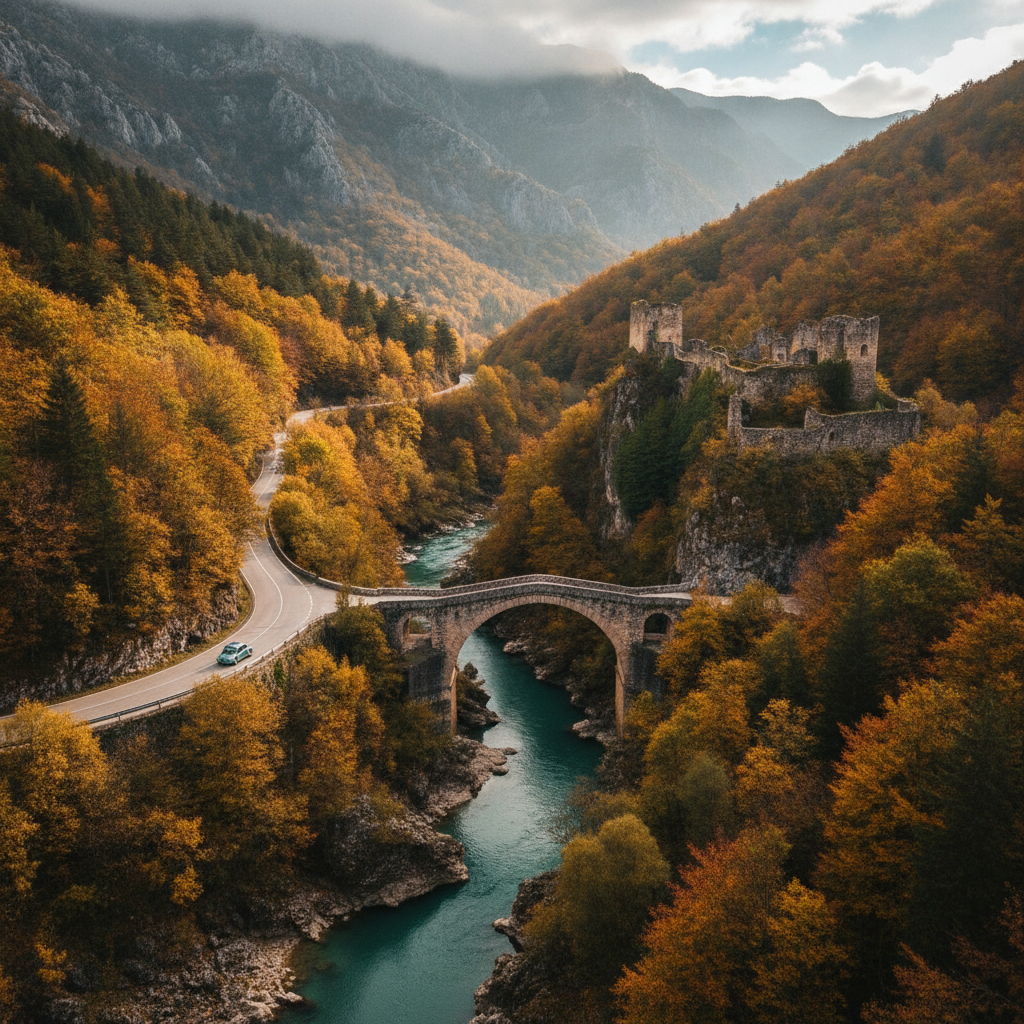
Every autumn, hundreds of thousands of travelers make their way down the Dalmatian Coast, tick off Dubrovnik, and head home convinced they've seen the best the region has to offer. What they've missed — sometimes just a two-hour drive inland — is one of the most rewarding and affordable corners of the entire Balkans, sitting quietly in early October with cooler air, almost no tourist infrastructure pressure, and prices that feel like a different era of travel entirely.
The Window That Makes October Worth Watching
Early October in Bosnia and Herzegovina's interior is a genuinely unusual moment. Summer has released its grip, but the mountain weather hasn't yet turned severe. The days in cities like Mostar and Jajce run comfortably warm — cool enough for walking without sweating through your layers, warm enough that you're not battling wind at every Ottoman-era bridge or waterfall overlook. The light at this time of year is softer, the golden-hour windows are longer, and the foliage across the surrounding mountains starts shifting in ways that photographers chase across Western Europe at three times the cost.
What this timing also means practically is that accommodation prices drop noticeably from their August peak. Mostar in particular — the city most visitors know from photographs of the Stari Most bridge — runs significantly quieter after mid-September. The guesthouses and family-run pensions that line the Old Town's cobblestone alleys often drop their nightly rates and suddenly have availability. You can book a clean, well-located room through Booking.com or Hostelworld for a fraction of what coastal Croatia charges for comparable comfort one month earlier.
Where the Real Value Sits: Cities and Mountain Towns
Mostar is the obvious anchor for any interior itinerary, and it earns that status. The Old Bazaar, the dervish house, the mosques and Orthodox churches crowded within walking distance of each other — the density of history per block is remarkable, and almost none of it charges significant entry fees. A full day of serious exploration costs almost nothing beyond food and whatever you choose to drink at one of the riverside cafes. Speaking of which: the local coffee culture is its own experience, and a copper džezva of Bosnian coffee at a proper café will rarely set you back more than the equivalent of a couple of euros.
Beyond Mostar, the case for slow movement through the interior gets stronger. Jajce — a fortified medieval town where a genuine waterfall drops directly into the town center — sees only a fraction of the visitors that Mostar handles, which means you can stand at that waterfall on an October morning with almost no one else around. Višegrad, further east, carries a complicated history but offers Stari Grad fortress views and an eerie, beautiful riverscape along the Drina. For travelers willing to move beyond the obvious stops, the value deepens with every kilometer.
The Bjelašnica mountain area, which sits roughly an hour from Sarajevo, offers a different kind of October entirely. The trails are walkable without summer heat, the villages are nearly empty, and the landscape has a quality that takes most visitors by surprise — it looks nothing like the Balkans of tourist brochures. Using Google Maps offline combined with Maps.me for trail detail gives you enough navigational confidence to explore these areas without paying for guided transport, which further compresses the daily budget.
Sarajevo as a Base That Actually Makes Financial Sense
Sarajevo deserves more credit as a budget travel base than it typically receives. The city has a functional, inexpensive tram and trolleybus network that makes getting around the urban core genuinely cheap. The Baščaršija — the Ottoman bazaar district — is a legitimate historic quarter, not a theme park version of one, and the surrounding neighborhoods run uphill in ways that reward explorers willing to walk. Accommodation in Sarajevo through early October sits well below what comparable European capitals charge, and the food costs less again: a sit-down meal with meat, vegetables, and bread at a local restaurant will come in at a price that makes Western European travelers do a double-take.
Flights into Sarajevo International have expanded in recent years, and budget carriers including Ryanair now connect it to several European hubs. This makes it a realistic point of entry for a trip that loops through the interior before optionally ending closer to the Adriatic coast. Running your flight searches through Google Flights with flexible date settings — especially across that late September to mid-October window — consistently surfaces fares that undercut what you'd pay to land in Split or Dubrovnik.
The other logistical advantage of using Sarajevo as your anchor is the intercity bus network. Bosnia's long-distance buses are reliable, inexpensive, and connect the major interior towns without requiring a rental car. You can reach Mostar, Jajce, and Trebinje from Sarajevo for well under what a single tank of fuel would cost on the coast. That saved transportation budget is better spent on an extra night's accommodation in a place that genuinely moves you.
What This Region Is Quietly Becoming
Bosnia and Herzegovina's interior is not a secret in the sense that it's completely undiscovered — it's a secret in the sense that the travel industry hasn't figured out how to charge for it yet. That gap won't last indefinitely. Mostar in particular is showing signs of the same pricing pressure that hit Kotor and Dubrovnik once they crested into mainstream awareness. The family guesthouses are still family guesthouses right now, but development follows attention, and attention is slowly arriving.
Early October is the last viable window before the mountain towns close down for the colder months, and it's the window where the combination of price, weather, and crowd levels aligns most favorably. If you've been watching this region from a distance — curious about the history, drawn in by the landscape, but uncertain about how the logistics and budget would work — the answer is that they work better now than they're likely to again for a while. The moment to start building that itinerary is before the rest of the crowd figures out what they've been driving past on the way to the coast.