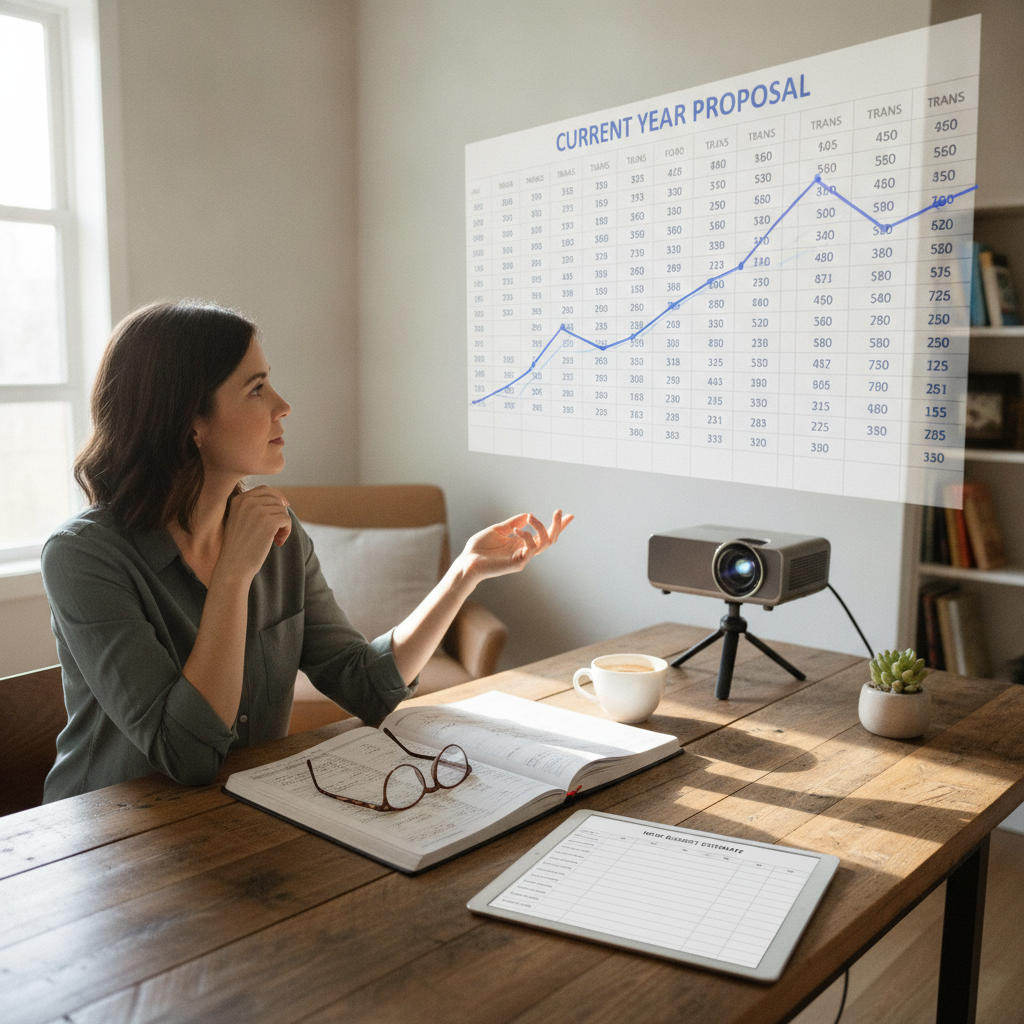
Most people build a new budget the same way they make a New Year's resolution — with optimism, a rough sense of what feels right, and very little grounding in actual behavior. The result is a financial plan that looks reasonable on paper but quietly unravels within weeks, because it was constructed from aspiration rather than evidence. There's a more reliable method, and it doesn't require guesswork: using last year's real spending data as the foundation for every category in the months ahead.
The Problem With Estimating From Memory
When people estimate their spending from scratch, they tend to recall the bills they pay attention to — rent, utilities, the streaming subscriptions they actively chose — and systematically undercount the irregular, forgettable, or emotionally uncomfortable ones. Grocery runs, pharmacy trips, small online purchases, and the occasional restaurant meal blur together into a vague figure that almost always falls short of reality. Behavioral research consistently shows that people misremember their spending as lower than it actually was. A budget built on that kind of compressed memory starts with a structural deficit it may never recover from.
How Historical Data Fills the Gaps Memory Leaves
Bank statements, credit card records, and apps like Mint or YNAB (You Need a Budget) preserve the transactions that memory discards. When last year's spending is categorized and totaled, a clearer picture emerges — one that includes the irregular expenses that don't appear every month but arrive reliably across the year. Annual subscriptions, car registration, back-to-school shopping, and seasonal utility spikes all show up in historical records. These are exactly the costs that a from-scratch estimate tends to miss, and they're often the ones that blow a budget when they finally land.
The Anchoring Advantage in Category-Level Planning
The real strength of the historical approach lies in category-level precision. Rather than assigning a round number to "food" or "transportation" based on instinct, a person can calculate what they actually spent in each category across twelve months and divide by twelve to find a realistic monthly baseline. That figure won't be perfect — spending patterns shift — but it provides a defensible starting point rather than a hopeful guess. Tools like Personal Capital or even a simple spreadsheet make this kind of monthly category averaging straightforward, and the resulting numbers tend to hold up under real-world conditions in a way that estimated figures rarely do.
Accounting for Inflation and Intentional Change
Anchoring to last year's data doesn't mean copying it unchanged. The process works best when historical figures are treated as a baseline that gets adjusted deliberately, not accepted passively. If grocery costs rose noticeably over the past year — as they have across most of the developed world — that category should be adjusted upward to reflect current pricing rather than last year's receipts. Similarly, if a person is trying to reduce dining-out spending or cancel an unused gym membership, those categories can be revised downward from the historical baseline with full awareness of what the previous number actually was. The data informs the budget; it doesn't dictate it.
Why This Method Surfaces Spending You'd Otherwise Budget Around
One underappreciated benefit of the historical anchoring approach is what it reveals about spending that a person might prefer not to confront. Categories that were easy to overlook during the year — convenience purchases, duplicate subscriptions, irregular impulse buys — show up clearly when twelve months of transactions are laid out and sorted. This isn't comfortable, but it's useful. A budget built without that visibility is essentially a plan that works on paper while leaving the most problematic spending patterns untouched. The historical method forces those patterns into view before the budget is written, rather than letting them undermine it afterward.
Building the Habit of Year-Over-Year Budget Review
For this approach to compound in usefulness, it helps to treat it as an annual practice rather than a one-time fix. If you set aside time each year — ideally before January or at whatever point your financial year naturally resets — to pull your actual spending data from the prior twelve months, categorize it, and use those figures to anchor the next budget cycle, the process becomes more accurate over time. Apps like Copilot or a well-maintained spreadsheet make retrieval faster each year. The categories get sharper, the anomalies become easier to spot, and the budget that emerges starts to reflect the financial life you're actually living rather than the one you imagined you were living when you wrote the numbers down.
Building a budget from real data rather than estimation isn't a complicated shift — but it's a consequential one. The broad observation that holds at the start holds at the end: a financial plan is only as reliable as the information it's built on, and memory is a poor substitute for records. Anchoring to last year's actual spending doesn't guarantee a perfect budget, but it gives every category a foundation in reality, which is where the most durable financial habits are built.